|
1
|
- Michael Green and Sean Walker
- (based on the work of previous TAs)
|
|
2
|
- Mon, November 1, 7-9 pm, Gates B01
- Mostly “short answer” questions
- Keep your answers short and sweet!
- Covers lectures up to Tuesday, Oct 26
- plus taxonomy from start of last lecture
- Review session slides available from class website
- Exam is closed book, closed notes
|
|
3
|
- CRTs
- 3 phosphors for “red”, “green”, and “blue”
- Triads and shadow mask
- Measures of spatial resolution
- physical vs. addressable resolution
|
|
4
|
- Sensitivity highest in fovea
- Frequency sensitivity
- Phase sensitivity (Vernier acuity)
- Temporal sensitivity
- Flicker (50-70Hz)
- Perceived motion
- 12 Hz = cartoons, 24 Hz = film, 60 Hz = video
|
|
5
|
- Human intensity sensitivity
- Response to intensity is nonlinear
- Gamma in cameras, CRTs
- Gamma correction
|
|
6
|
- Sample (easy) question:
- A scene is photographed with a TV camera with gamma=0.5 and displayed
on a CRT with gamma=2.4. If we
want system gamma to be 1.0, we should do gamma correction with what
exponent?
|
|
7
|
- Perception of color
- Humans are trichromat
- Three cones sensitive to “red”, “green”, and “blue”
- Overlapping response curves
- Know their general shapes!
- Color matching
- Color matching experiment
|
|
8
|
- Linear colorspaces
- r, g, b space (perceptual stimulus)
- R, G, B space
- X, Y, Z space
- Non-linear colorspaces
- Spectral locus
- Gamut of reproducible colors
|
|
9
|
- Sample questions:
- 1. Circle those colors that are
not reproducible with a single monochromatic light
- Red
- Yellow
- Blue
- Magenta
- White
- Green
|
|
10
|
- Sample questions:
- 2. If you had a special CRT that could produce pure spectral colors,
how many spectral colors would you need to represent a normal RGB color
gamut? How about the spectral locus?
|
|
11
|
- The sampling and reconstruction pipeline:
- Prefiltering
- Sampling
- Resampling
- Reconstruction
- Aliasing in the frequency domain
- Filtering and convolution
- Duality: F(x)*G(x) <=> F(w)G(w)
|
|
12
|
- Prefiltering vs. postfiltering
- Desirable filters for antialiasing
- Box, pyramid, gaussian, sinc
- Methods of antialiasing
- Supersampling: regular vs. stochastic
- Analytical antialiasing
|
|
13
|
- Sample questions:
- What is the result of convolving a 1-D box filter with itself?
- Which of the following would affect your choice of a reconstruction
filter?
- pixel shape
- choice of prefilter
- actual size of display
|
|
14
|
- Rasterization of lines
- DDA, incremental algorithm
- Rasterization of polygons
- Only pixels in the polygon
- Supersampling
- Patterns: understand its effect on the image
|
|
15
|
- Sample question:
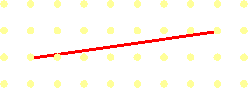
- If you rasterized this line using DDA, which pixels would get turned
on?
|
|
16
|
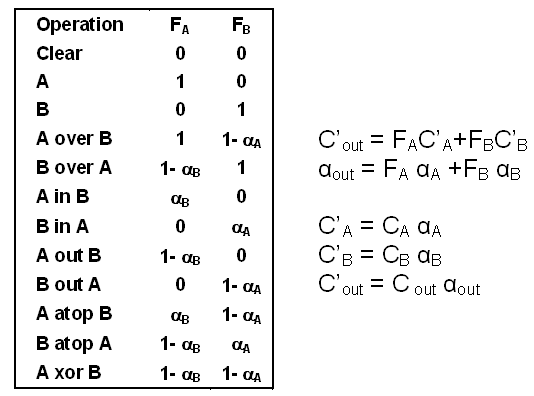
- What is compositing?
- The compositing approximation
|
|
17
|
|
|
18
|
- Sample question:
- You are doing the special effects for a movie, and need to composite a
computer generated object over a live background. Why should you use an 8-bit alpha
matte rather than a binary (1-bit) matte, even if the computer-generated
object is fully opaque?
|
|
19
|
- Homogeneous coordinates – why?
- Matrices rotation, translation, scale, shear in 2D, 3D
- Know the form of each kind
- Geometric properties preserved/changed by each kind
- Composing transformations
- multiply matrices in reverse order
|
|
20
|
- Sample questions
- Compute the 2D transform that translates an object centered at (-3,4) to
the origin, then rotates it by +45o, then translates it to
(10,5).
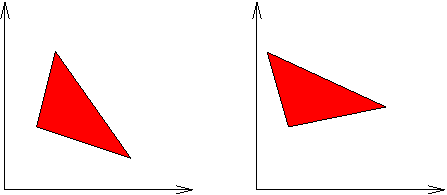
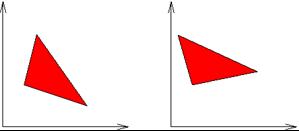
- What sequence of transforms would cause the triangle to change as shown
below ?
|
|
21
|
|

 Notes
Notes