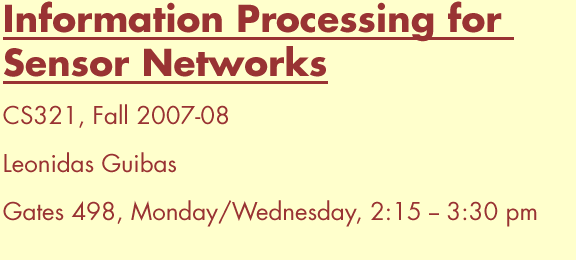
From Monday, October 1, 2007, CS321 will meet in Gates 392.
|
COURSE DESCRIPTION: The advent of low power, small form factor devices that combine sensing, processing, and wireless networking makes it possible to monitor and
observe the physical world at a scale that was impossible beforehand.
For the better part of a decade now such wireless sensor network
systems, incorporating many `mote' devices, have been of great interest
in both academia and industry, leading to early applications in
infrastructure and building monitoring, business asset management and
tracking, heath-care delivery, disaster recovery, and location-aware
services. However, both the deployment and management of such
distributed systems present many unsolved challenges, due to the
fragile nature of the devices themselves, the volatility of wireless
links, and the basic difficulty of architecting a reliable system out of
unreliable components. The issue of how multiple such systems will be
able to co-operate and how they will be integrated into the next
generation Internet also remains largely unaddressed. PREREQUISITES: The course presumes a basic knowledge of networking and algorithms. Background material will be presented as needed, including a quick introduction to TinyOS and network simulators. GRADING: The class requirements include:
These pages are maintained by Leonidas Guibas guibas@cs.stanford.edu.
|