BLOOPERS
Here, in these hallowed halls you shall see the most imfamous vision algorithms fall flat on their face when presented with some of our diving photage.
Yes. You heard right. You will see the revered Lucas-Kanade algorithm EXPLODE as the optical flow goes hay-wire. You will see contours wander around aimlessly as they have lost track of the boundaries. You will even see condensation float around as if posssessed by a devil. Finally, you will see various hacks that have also failed to work.
This is presented to warn those novice vision aspirationists as to the dangers that may befall them if they choose an underconstrained and undercontrolled scene to analyze.
Blooper 1: Locality gone Loco
In this first blooper, we apply a locality filter where hypothesized silhouette values are "local" to the previous silhouette, but this turned out disastrous since the locality constraint couldn't keep up with the moving diver. Click here for the movie.
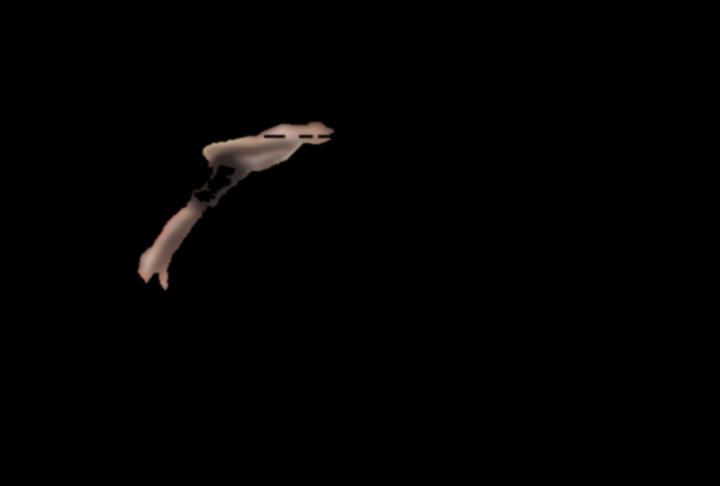
Here it seems ok, that locality filter is working..but wait 'till the
diver starts moving!
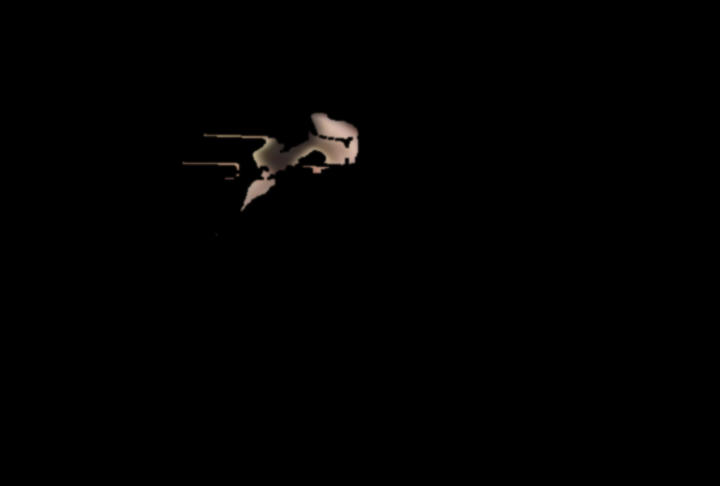
Hmm..something is odd.. the head is starting to disappear!
Blooper 2: Lucas-Kanade explosions
In this next blooper, we're given a fairly good segmented image, for which we track optical flow for pixels with non-zero values. However, LK doesn't like this image very much (pixel optical flow is too fine) so it just simply explodes!
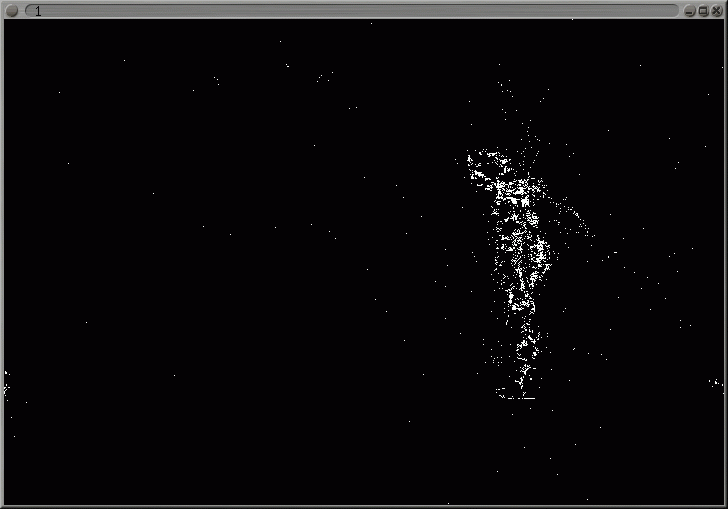
The white pixels represent pixels where there is color information
(tracked pixels). As you can see, pixels are all over, and pixels in the
original silhouette start to thin out....talk about a disappearing
man..
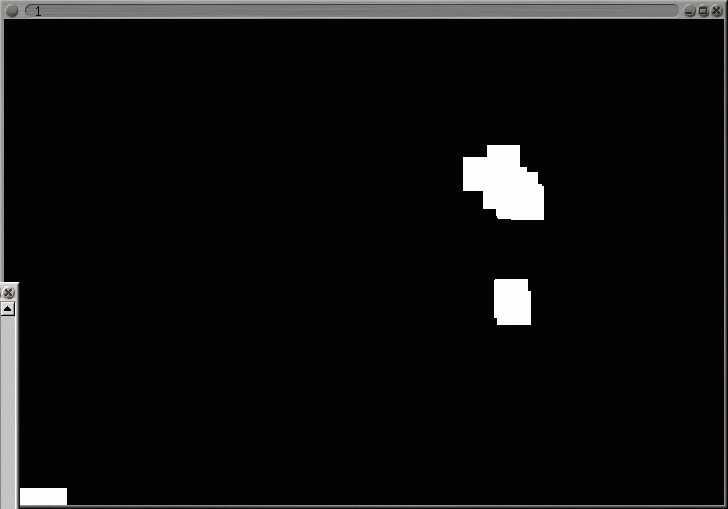
Here we try to fix the damage by first eroding to remove the noisy
pixels and then dilating to recover the silhouette, but we can't revive
the dead image.

Here we try the reverse: first dilating to expand the silhouette, then
erosion to remove the noisy pixels..but the image is stubborn.
Blooper 3: Lost Contours
In this blooper, we were tackling the problem of identifying the diver pixels in the post-segmented image. Suppose we looked at the contours of the image. Since the largest blob SHOULD be the diver, then we could look at the contour which has the largest line integral, and this should be the contour of the diver. However, the contours we not connected in a circle and were very broken -- sometimes even connecting contours between diver and background!
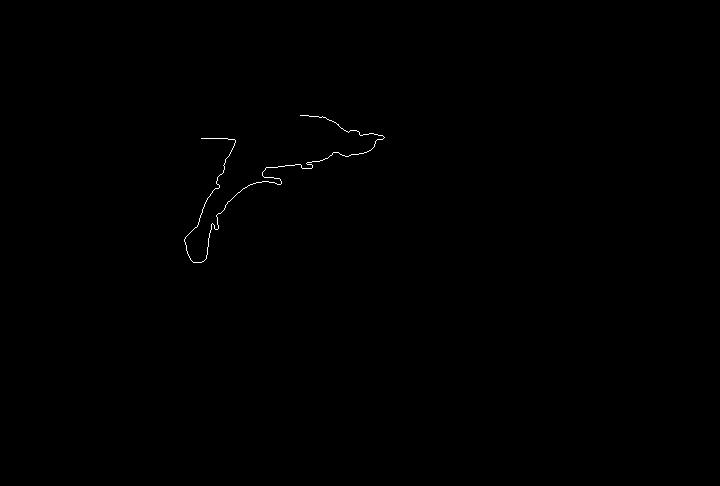
Here the contours look promising -- we can make out the silhouette of
the diver. But the best is yet to come!
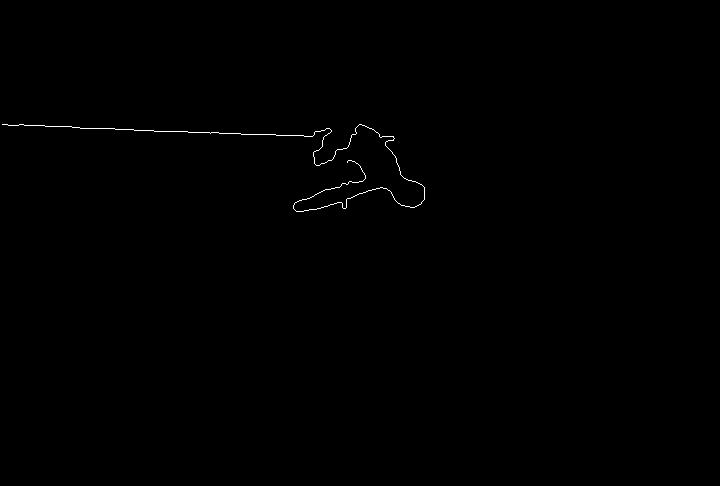
A few frames later, the diver contour is beginning to merge into the
background!!!
Blooper 4: A Possessed Condensation Algorithm
In this blooper, taking a post-segmented image, we apply the condensation algorithm to track the diver.. but the noise in this particular movie turns out to be too overwhelming, and the it tracks random stuff.Click here for the movie.