Rendering Translucent Materials
Henrik Wann JensenStanford University
http://graphics.stanford.edu/~henrik
Abstract
Accurately simulating the scattering of light by materials is fundamental for realistic image synthesis. Even the most sophisticated light transport algorithms fail to produce convincing images if the local material models are too simple. Traditionally, computer graphics has based the development of material models on the assumption that light scatters at a single point on the surface. This assumption is only valid for metals, and notably it breaks down for translucent materials, such as snow, plants, milk, cheese, meat, human skin, cloth, and marble. To capture the smooth and soft appearance of these materials it is essential to simulate subsurface scattering - the scattering of light inside the material.
In this talk I will present two practical techniques for simulating subsurface scattering. The first technique uses photon tracing and photon mapping to simulate both single scattering and multiple scattering inside the material. The photon mapping algorithm is significantly faster than other Monte Carlo based methods, but it becomes costly for highly scattering materials such as milk and skin. This observation has resulted in the development of a new technique based on a diffusion approximation. The diffusion approximation is faster (by several orders of magnitude) than previous approaches for rendering translucent materials and it is the first theory that extends the traditional point based reflection model (BRDF) paradigm in computer graphics and uses a BSSRDF - Bidirectional Scattering Surface Reflectance Distribution Function. In addition, the theory is sufficiently accurate that it can be used to measure the scattering properties of translucent materials.
I will show several rendered animations and images of translucent materials including marble, milk, and skin, that were generated using these techniques.
Dr. Henrik Wann Jensen is a Research Associate at Stanford University where he is working in the computer graphics group on realistic image synthesis, global illumination, and new appearance models. His contributions to computer graphics include the photon mapping algorithm for global illumination, and the first BSSRDF for simulating subsurface scattering in translucent materials. He is the author of "Realistic Image Synthesis using Photon Mapping", AK Peters 2001. Prior to coming to Stanford in 1999, he was a postdoctoral researcher at MIT, and a research scientist in industry where he added photon maps to a commercial renderer. He received his M.Sc. and Ph.D. in Computer Science from the Technical University of Denmark.
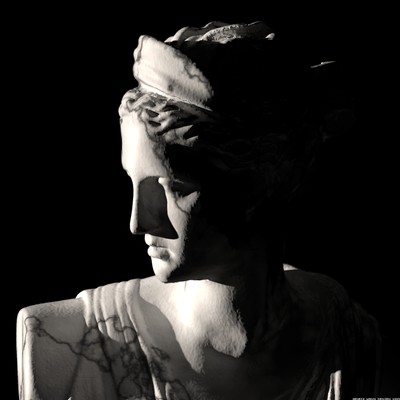
Traditional computer graphics techniques produces a hard computer-generated look.
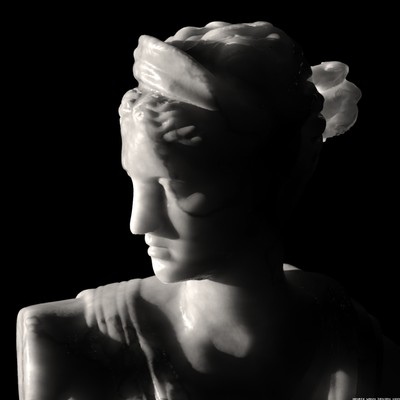
Our photon mapping simulation correctly simulates the spread of light through the translucent marble bust.
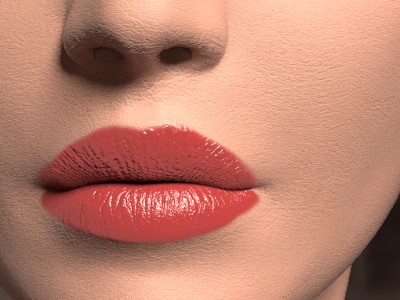
Face rendered using the traditional BRDF based approach.
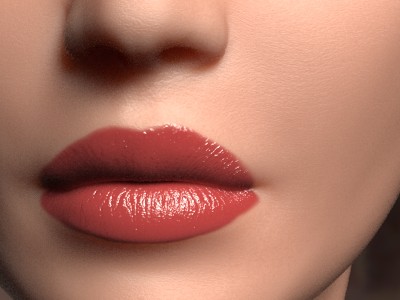
Face rendered using our new BSSRDF technique.