Final Project Proposal
CS 348B: Image Synthesis Techniques, Spring 2003
Rendering Realistic Animal Fur
| Michael Turitzin turitzin@ |
Jared Jacobs jmjacobs@ |
Goal and Why It Is Interesting
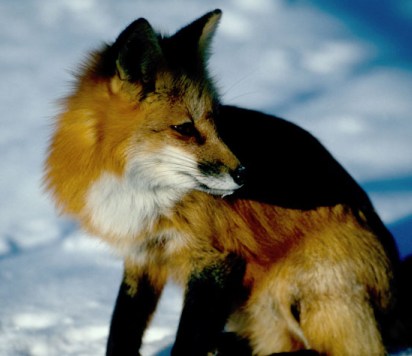
We intend to render a scene consisting of primarily a furry animal, such as a dog, leopard, or panda. We are aiming for a detailed, realistic fur rendering that closely models the appearance of the depicted animal. This means that fur will vary in color, length, and texture across the animal's body. We want to create a moderately detailed scene (more than just the animal floating in a vacuum). We are hoping to extend our fur model to render a grassy field or carpet for the scene. Feel free to keep tabs on our results.
Key Technical Challenges
As Kajiya and Kay explain, fur has traditionally been difficult to render correctly because of the modeling complexity and aliasing problems that microgeometry presents. Some have proposed volumetric techniques and even sophisticated billboarding as useful approximations. The fur must reflect light believably when viewed head-on, but must also extend beyond the modeled surface at its silhouette.
Some issues we will address are dividing the furry surfaces into small squares to serve as the fur texel bases, and creating bilinear patches to represent the outer fur surface. To our knowledge, modeling transitions between different kinds of fur on the same model is a problem that has not been addressed in the literature.
Our Approach
Our primary source of inspiration will be Kay and Kajiya's well-known paper on fur rendering [1], but we hope to incorporate techniques from other sources we have found as well. We will attempt extending Kajiya and Kay's methods in directions they suggest but do not implement themselves, such as using a particle system to initialize fur texel volumes instead of just straight lines normal to the model surface. We will acquire the appropriate model(s) and apply our fur "texture" with all relevant fur information (e.g. color, length, thickness). We will extend LRT appropriately in order to correctly perform ray intersections with the fur and to light it.
Tasks/Duties
- Obtain the animal model and initial texture map
- Assign fur properties to the animal surface
- Design and model the scene
- Write code to generate fur texels using particles based on properties read from a file
- Write code to apply fur texels to the animal's surface (bilinear patches)
- Write ray-texel intersection and texel light transmission/reflection code.
References
[1] J. Kajiya and T. Kay. Rendering Fur with Three-dimensional Textures. SIGGRAPH Proceedings, 1989, pp. 271-280.
[2] J. Lengyel, E. Praun, A. Finkelstein, and H. Hoppe. Real-Time Fur Over Arbitrary Surfaces. Symposium on Interactive 3D Graphics, 2001, pp. 227-232.
[3] K. Perlin and E. Hoffert. Hypertexture. SIGGRAPH Proceedings, 1989, pp. 253-262.