Last updated June 2009
(As of July 2014 I am Emeritus and no longer taking new PhD students.)
One of the great pleasures of being at Stanford is interacting with its talented and enthusiastic faculty, staff, and students. Described below are some of the research projects we are working on together. Aside from publishing technical papers about these projects, we often package and release our software and our data.
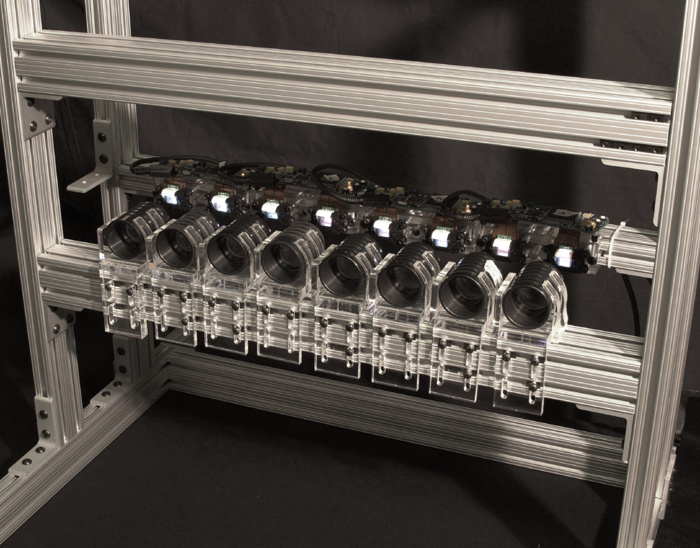
Measurement technologies for graphics. I like building things. Over the past 15 years, my students and I have built devices for measuring 3D shape, light fields, and reflectance functions. These particular devices all included a mechanical component. However, the trend is towards optoelectronic solutions. With this in mind, we've developed a real-time range scanner based on video projectors, a handheld camera for capturing instantaneous light fields, a multi-camera array for acquiring video light fields, and a light field microscope for capturing light fields of tiny biological specimens. The latter two projects were collaborations with Pat Hanrahan, Mark Horowitz, and their students.
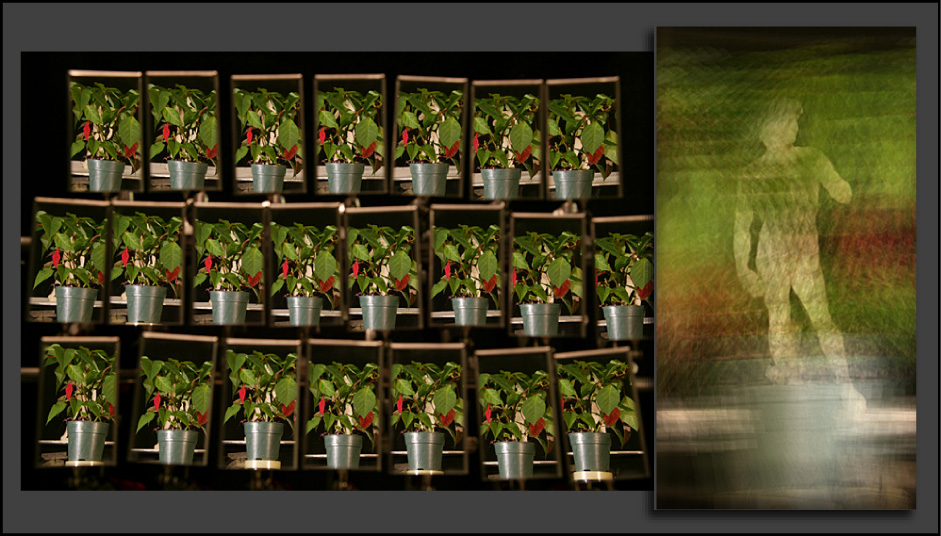
Light fields and related ideas. A light field is a 2D array of (2D) images, each taken from a different viewpoint. Here's a gentle introduction to the idea. The resulting 4D array completely characterizes the passage of light through unoccluded space. By assembling pixels from several images, new views can be constructed from observer positions not present in the original array. This idea was described by Pat Hanrahan and myself in a 1996 Siggraph paper. The Stanford multi-camera array (mentioned above) has given us a unique device for exploring applications of light fields, including high-speed video using a dense camera array. Starting with the experiments leading up to our 1996 paper (see the historical note on this web page), we began playing with the optical effects of shearing the 4D light field array. This led us to discover two (digital) optical effects: synthetic aperture photography (SAP), in which one combines closely spaced views of an object, thereby letting us see through partially occluding objects like foliage, and synthetic aperture illumination (SAI), in which one physically projects multiple images onto a common plane in space, thereby creating a synthetic image with an extremely shallow depth of field. Here's a paper about calibrating our camera array for synthetic aperture photography, here are some examples of seeing through people, and here's an array of miniature video projectors we once built to further explore synthetic aperture illumination. Using these two optical effects, we have implemented a discrete approximate of confocal imaging, a technique borrowed from microscopy. This approximation lets us selectively image or illuminate one object in a complex scene, and it lets us see further through scattering environments (such as turbid water) than is otherwise possible. For a while we also explored techniques called dual photography and symmetric photography, which use Helmholtz reciprocity to swap the cameras and light sources in a scene. These techniques allow us to produce images from viewpoints in the scene where a camera never stood. As you can see, we enjoy playing with the theoretical aspects of light fields. Our latest forays in this vein are a paper on general linear cameras with finite aperture and a paper on Wigner distributions (familiar to the radar community) and how they relate to light fields. The latter effort won Best Paper at the First International Conference on Computational Photography (ICCP 2009). Finally, we worked for a while on multi-perspective imaging, with an eye towards visualizing urban landscapes, and animating light fields by interactively deforming its defining ray space. The CityBlock project has since been taken over by Google, where it is better known as StreetView.
Digital refocusing and its applications. Synthetic aperture photography (SAP) and synthetic aperture illumination (SAI), introduced in the foregoing paragraph (and in concurrent work by other groups in the early 2000's), are now more commonly known as digital refocusing (of views and light). In this guise, they have become hot topics in the computational photography community. In our lab, one of the outcomes of this research was the handheld light field camera (mentioned above) built by PhD student Ren Ng, which gives a photographer the ability to refocus an ordinary snapshot after it has been taken. This dramatic effect must be seen to be believed; check out the video on this web page, or the web page of Ren's startup company, Refocus Imaging. By the way, Ren's PhD thesis won the 2006 ACM Doctoral dissertation Award. Recently, we adapted this idea to microscopy, by inserting a microlens array into a conventional microscope. The resulting light field microscope (LFM) can produce perspective flybys, focal stacks, and volume datasets from a single photograph, and therefore at a single instant in time. By inserting a similar microlens array into the illumination path of the microscope, one creates a light field illumination (LFI) system, which can be used to reproduce exotic microscope illumination modalities or to create focused spots or shapes of light anywhere in 3D inside a specimen. Combining the LFM and LFI, we can measure and correct for the aberrations that arise when imaging through optically uncooperative specimens (as many of them are).
Computational photography. Computational photography refers broadly to sensing strategies and algorithmic techniques that enhance or extend the capabilities of digital photography. The output of these techniques is an ordinary photograph, but one that could not have been taken by a traditional camera. Our light field camera is a kind of computational photography, but so is high dynamic range imaging, flash-noflash imaging, coded aperture and coded exposure imaging, photography under structured illumination, multi-perspective and panoramic stitching, digital photomontage, and all-focus imaging. In our lab, aside from our work on light field imaging, we've worked on reducing veiling glare in cameras by inserting a mask between the camera and the scene, reducing the deer-in-the-headlights look of flash pictures by shaping the flash spatially using a video projector, and playing with high-dimensional bilateral filtering using Gaussian KD-Trees. Finally, in response to a growing feeling that progress in some aspects of computational photography has been hampered by the lack of a portable, programmable camera platform with enough image quality and computing power to be used for everyday photography, we have been looking into computational photography on cell phones. At the same time, we are building an open-source camera platform that runs Linux, is programmable and connected to the Internet, and accommodates SLR lenses and SLR-quality sensors. Our goal is to distribute this platform, which we call Frankencamera, at minimal cost to computational photography researchers and courses worldwide. We've lumped these last two projects under the banner Camera 2.0. By the way, the phrase "computational photography" has been re-invented several times over the last 20 years. Its current incarnation arose from a course by that name I first offered at Stanford in 2004 (here's the most recent version of that course) and from a symposium I co-organized with Fredo Durand and Rick Szeliski at MIT in 2005.
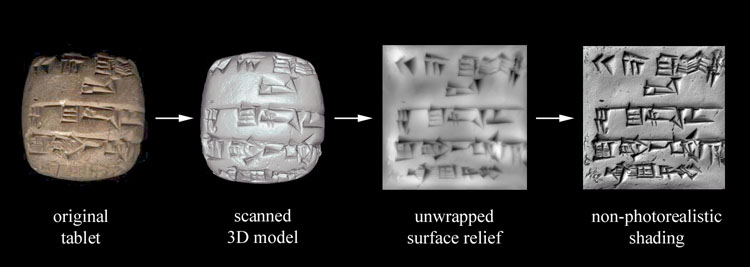
Graphics in the service of the humanities. My original training is in architecture (buildings, not computers), so whenever I can I try to blend technology and the humanities in my research. One such effort was the Digital Michelangelo Project, a 5-year effort to create a three-dimensional digital archive of the statues of Michelangelo. Although the project is now dormant, we managed to create reasonably good computer models of 2 of the 10 statues we scanned. These models, and our raw scan data for the other 8, are available to scholars through our online archive. Another project at the juncture of technology and the humanities was our digitization of the 1,186 fragments of the Forma Urbis Romae, a giant marble map of ancient Rome. With guidance from Jennifer Trimble in Classics, we created a geometric, photographic, and textual database of the map, and with help from Leo Guibas and his students, we tried to solve the jigsaw puzzle algorithmically. In the two years we worked on this problem, we found about 20-40 matches (depending on how many you believe). That may not sound like much, but it's more than human archaeologists have found in 30 years. (Here's a blurb on our first match, and here's an article from the Stanford Report describing the whole project.) Papers describing the project in more detail, and enumerating all the matches we found, appear in the Journal of Roman Archaeology and the Bullettino Della Commissione Archeologica Comunale di Roma. Another project with an archaeological flavor was the Cuneiform Tablet Visualization Project, in which we scanned, unwrapped, and non-photorealistically shaded the tablets' curved inscribed surfaces. Finally, the task of assembling archives of Michelangelo's statues and the Forma Urbis Romae led Hector Garcia-Molina and I to think about the problems of creating digital archives of 3D artworks. Our efforts in this area focused on real-time display of large models on low-cost PCs, efficient streaming of these models over networks of limited bandwidth, and protected viewing for non-licensed users via a remote rendering system, which is available for download (currently only for Windows PCs, I'm afraid).
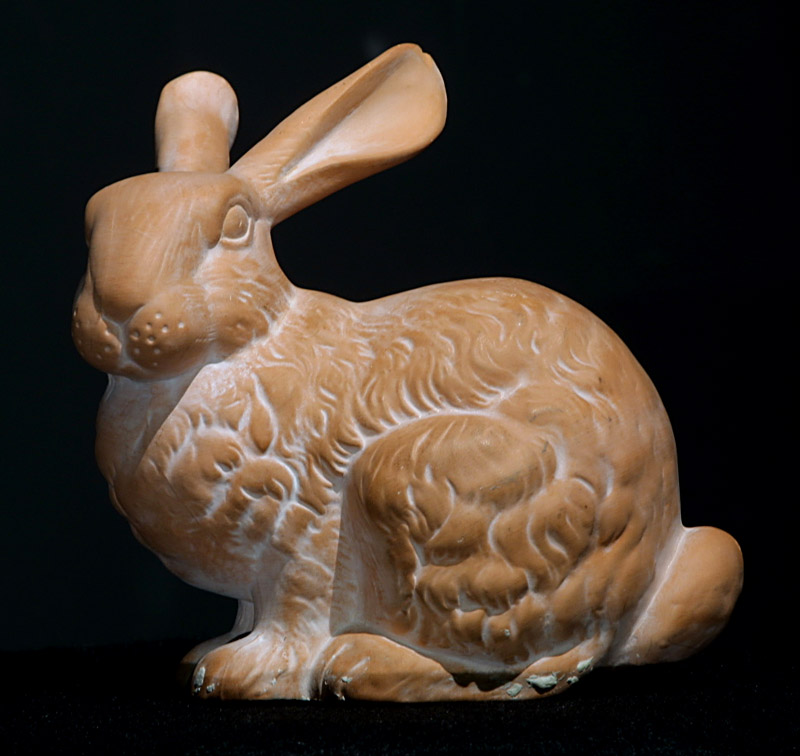
Other fun follow-on projects. The ability to create high-resolution computer models of statues has presented us with some unexpected opportunities. For example, the Galleria dell'Accademia in Florence invited us to install a computer kiosk near Michelangelo's giant figure of David. Between November of 2002 and the present (2009), about 7 million visitors have seen this kiosk. Our hope is that by allowing museum visitors to interactively rotate (and relight) our model of the statue, they can examine parts of the statue that are hard to see from the ground, like his head and hands. We've also begun making physical replicas of the David; I have one sitting in my display case, right next to the notorious Stanford bunny. Something else we've looked at is projecting images onto scanned objects using powerful (and carefully aligned) video projectors. Possible applications include visually canceling dirt as a planning aid for art conservators, recoloring ancient statues (that were originally painted), and, inspired by the Son et Lumiere shows of France, non-photorealistically coloring a statue to look like a 3D drawing or painting.
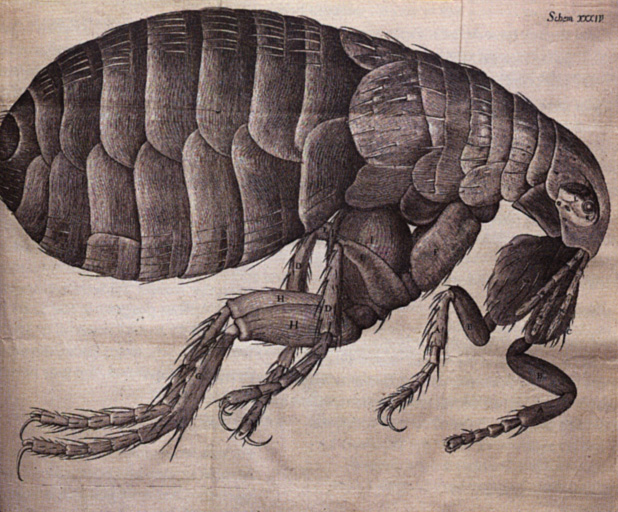
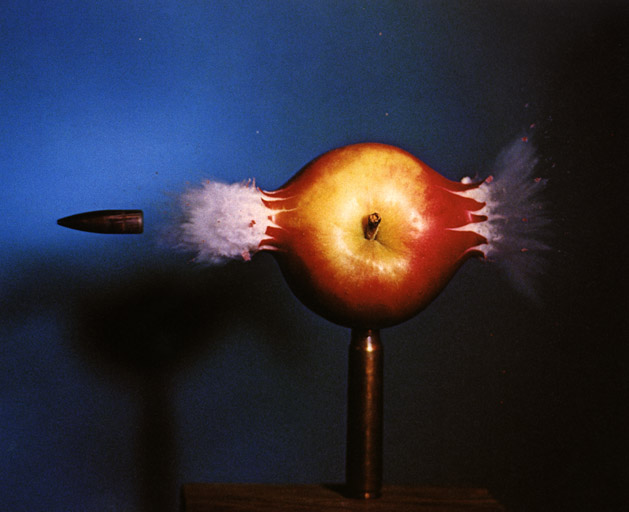
Volume rendering, point-based rendering, and visualization. In a previous life, I worked on volume rendering. (We still maintain Phil Lacroute's popular Volpack package and an archive of volume datasets.) Volume rendering is now a mature research area and a core part of the billion-dollar data visualization software industry. (Too bad I didn't start up a company in this area!) Among the many books on the subject, my favorite is by Hadwiger, Kniss, Rezk-salama, and Engel (2006). Although I am no longer actively working in this area, I've become interested in alternative ways of visualizing the three-dimensional structure of the natural world. Inspired by landmark books like Robert Hooke's Micrographia (1665) and Harold Edgerton's Stopping Time (1964), I have begun working on a book of volume renderings. The book will be called Volumegraphica. Another inactive project is my spreadsheet for images. Many people have asked me for this software; one day I might clean it up for distribution. Finally, I continue to think about the use of points as a display primitive. Although this approach proved impractical in 1985, the highly successful QSplat system is based on it, and the first Symposium on Point-Based Graphics was held in June 2004. There's now a book on the subject, edited by Gross and Pfister (2007), to which I contributed a small chapter.
Click here for a list of
my publications.
Click here for a list of all the
publications from our laboratory.
Click here for a list of all the
research projects going on in our laboratory.