FCam::SharpnessMap Class Reference
A sharpness map returned by the sharpness map generator. More...
#include <Base.h>
Public Member Functions | |
| SharpnessMap () | |
| The default sharpnes map carries no data. | |
| unsigned | operator() (int x, int y, int c) |
| Return sharpness at a particular location in a particular channel. | |
| unsigned | operator() (int x, int y) |
| Return sharpness at a particular location in the sharpness map summed over all channels. | |
Public Attributes | |
| bool | valid |
| Is it safe to dereference data and/or call operator(). | |
| unsigned | channels |
| How many channels are there in the sharpness map. | |
| unsigned * | data |
| The raw sharpness data. | |
Detailed Description
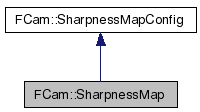
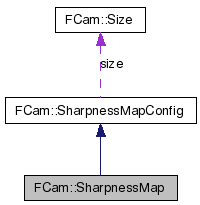
A sharpness map returned by the sharpness map generator.Has all the properties of SharpnessMapConfig and also an actual sharpness map. The sharpness map is the absolute value of a high-pass IIR filter summed over each region.
Definition at line 229 of file Base.h.
Constructor & Destructor Documentation
| FCam::SharpnessMap::SharpnessMap | ( | ) | [inline] |
Member Function Documentation
| unsigned FCam::SharpnessMap::operator() | ( | int | x, | |
| int | y, | |||
| int | c | |||
| ) | [inline] |
Return sharpness at a particular location in a particular channel.
The order of the channels is RGB. The absolute sharpness carries only relative meaning, and depends on the particular IIR filter used by the implementation. Be aware that due to Poisson noise, brighter regions will have a higher response. These numbers can be quite large, so if you're summing up the sharpness map, you should take care to prevent overflow.
| unsigned FCam::SharpnessMap::operator() | ( | int | x, | |
| int | y | |||
| ) | [inline] |
Member Data Documentation
| unsigned FCam::SharpnessMap::channels |
| unsigned* FCam::SharpnessMap::data |
The raw sharpness data.
The meaning of this data is platform-specific. On the OMAP3430, this is packed in a somewhat strange format, with 12 unsigneds per region, broken into four unsigneds per channel in the order RGB. The first unsigned for a given channel is the summed pixel values in that channel over that region. The second is the sharpness value. The third is the output of a different IIR filter, which is currently pretty much the same as the original IIR filter. The fourth unsigned should always be zero. The values in the green channel are roughly twice that in the other channels, because sharpness maps are computed on the raw sensor data, and sensors typically have twice as many green pixels as red and blue.
The documentation for this class was generated from the following file: