


Next: Calibration
Up: Building a Projection Autostereoscopic
Previous: Introduction
Figure 1:
A high level illustration of the
display pipeline. It begins with scene geometry on the left and ends at
observer.
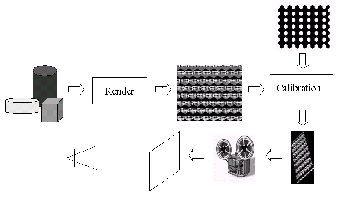 |
The process of displaying a 3D image on an autostereoscopic display is
displayed in Figure 1. Information about the scene,
which can be represented as light fields or traditional computer graphics
models is piped through a rendering process which outputs an image
composed of hexagonal subimages. This composited image goes through a
calibration function which warps the image. The calibration function's
parameters are set during a calibration phase with an appropriate
calibration image. After warping, the display image is sent to the display
device, where it is viewed by an observer.
The two critical steps in this pipeline are the calibration and rendering
steps. Calibration bridges the gap between world coordinates as observed
by a viewer, and the image coordinates. Rendering images resamples the
plenoptic function, which is represented explicitly as a light field or
implicitly by geometry. The resampled light field is parameterized by the
description of the display device.
Subsections
Next: Calibration
Up: Building a Projection Autostereoscopic
Previous: Introduction
Billy Chen
2002-06-10