Tracking Synchronized Divers
|
|
PEOPLE
- Billy Chen <billyc@graphics.stanford.edu>
- Leslie Ikemoto <leslie@graphics.stanford.edu>
- KarWaii (Sammy) Sy <sammysy@cs.stanford.edu>
SUMMARY
|
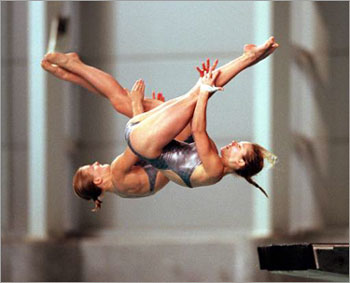
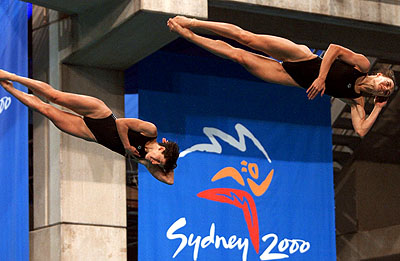
Synchronized diving was introduced at the 2000 Summer Olympics in Sydney,
Australia. It features two divers who perform either on the 3-meter
springboard or 10-meter platform using similar dives. Judges review
the dive based on the execution form of the invidual diver and the
synchronization of the duo, with more weight on the latter. [1]
Since the judges only have a few minutes to decide on an overall score, a computer-assisted measure for synchronization between two divers is very useful. Our proposed algorithm consists of three parts: image segmentation, tracking, and disparity calculation. Each of these parts have three layers of detail (LOD). Each LOD is progressively more accurate, but more computationally expensive:
Our final implementation computes the Motion History Image gradient calculation [Bradski, J. Davis 2000] and finds disparities between dives based on the differences between two fitted parabolas. The trajectories of the divers are found using color segmentation and tracking, and a parabola fit over each diver's trajectory. The disparity is based on the difference between the affine map that takes one dive to another and the identity matrix. However, Bradski, et. al assume a controllel background whereas diving can occur in any general environment. Hence much of our efforts have been directed toward developing a generalized silhouette extractor which involves both segmentation and tracking. In addition, we implemented a parameterized model of articulated image motion [Ju,Black,Yacoob 1996]. After an initial model is first constructed manually to match the first frame of the photage, a greedy hill climing search is used to update its parameters minimizing an error function on subsequent frames. Error is defined by the square of difference (SSD) between the the grayscale intensity values and projection of the 2D model. With good skin segmentation and tracking, the parameterized model converges more readily, providing richer information about the diving performance. |
[1] http://www.worldwideaquatics.com/olympics/aboutdiving.htm